
|

Specialised Power systems for Service Van, HGV truck,Caravan,Motorhome,Ambulance,Catering Trailer,4x4,Utility Vehicles, Canal boats, Marine . Mobile installation service available in
Telford & Shrewsbury, Shropshire areas.


Mobile onboard power at 240 volts AC is required on many types of vehicles
including
Leisure vehicles with living accomodation such as Motor home, Caravan, Camper van.
Vehicle Conversions where a panel van or truck has been modified for specialist utility service use and
may operate 240 volt or 110 volts powered equipment.
Exhibition display vehicles , library vans, etc which have 240v interior lighting and services,
Ambulances with 240 volt medical equipment and lighting.Mobile Shops and libraries where 240v power is required to operate a computer for stock control or invoicing, and extra display lighting is required. Interior lighting may be 12v or 240v
Marine craft eg, Sailing yacht , motor boat,canal barge, with living accomodation.
System Voltage
Most conventional vehicle battery charging systems operate at either 12 volts DC or 24 volts DC ( commercial vehicles) . UK domestic appliances operate at 240 volts AC mains . Portable tools for site work ,eg drills, grinders,etc may operate at 110 volts.
Various systems exist for supplying 110v or 240 volt AC onboard power depending on application and requirement.
A suitable power source can be supplied from a mains "hookup", dedicated generator, or conversion of existing vehicle electrical power to the required current and voltage types using an "Inverter"
Inverters
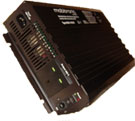
The Inverter converts the the vehicle's conventional 12 or 24 volt DC supply to 110 or 240 volts AC.
The Inverter output may be Pure Sine Wave (more expensive type) or Modified Sine Wave (cheaper type).
Inverter units may be linked to achieve larger power output or a dynamic inverter system used.
A "leisure" or "domestic" (deep cycle) battery bank is often used as the 12v or 24v power source to supply the inverter system.
Battery Charging
The vehicle's single alternator may be used to recharge both starter battery and leisure battery through use of a split charge relay or battery management system which allows switching between battery banks. The vehicle can be fitted with more than one alternator, for example no.1 alternator to charge the starter battery and no.2 alternator to charge the leisure battery or both linked to provide greater output capacity.
Alternative energy sources may be used to recharge leisure batteries such as use of solar panel battery charger or wind
powered generator if sufficient capacity can be achieved.
Split Charge Systems for Seperate Battery Banks
A split charge system seperates vehicle starter and leisure battery until after the vehicle engine is started then links both battery banks. This prevents the inverter system discharging starter and leisure batteries to a level at which starter motor operation fails. Additional batteries may be linked to the starter battery by use of heavy duty solenoid relay etc to provide cold starting assistance provided the connecting cables and relays are specified to carry high starter motor current draw .
An effect of lowering starter battery voltage results in an increased current draw as the starter motor operates (see Ohms law ref : Power(Watts)=Current(I) x Voltage(v) ) causing premature failure of starter motor or cabling.
Where a site hookup (via BS4343 connector) is available a battery charger may be used to recharge the leisure battery bank
whilst the vehicle is stationary.
Generators
110 volt or 240v power can also be acheived by a vehicle engine powered generator system, or by a stand alone portable
generator. 415 volt Three phase power for heavy duty specialist & industrial applications may be provided by a larger diesel powered generator.
Auxilliary power systems may be integrated so that the inverter system and generator systems work together during periods
of peak demand.
Safety & Circuit Protection
240 volts ac power circuits must incorporate the following: Residual Current Device ( RCD ) with adequate earth bonding to provide protection from electric shock
Overload protection
Short circuit protection
Please note ! Automotive electrical cable intended for use on low voltage systems is not suitable for use on systems operating at mains voltages (Why? Higher voltage potential requires better cable insulation) .

Electrical Installations in caravans and motor homes should comply with section 608-** of the IEE 16th edition Wiring Regulations.
" soon to be superceded by the 17th edition IEE Wiring regulations which apply after July 2008.
Periodic Inspection preferably not less than once every three years or more frequently if the vehicle is used for more
than normal mileage.For such vehicles , the caravan electrical installation and supply cable should be tested and a report
on their condition obtained as prescribed in BS7671 (formely the Regulations for Electrical Installations) published by the
Institution of Electrical Engineers.
Reducing Power Consumption
Consider using energy saving low power consumption devices such as LED Lighting when specifying your vehicle installation. This will mean the power requirement from the vehicle batteries is reduced therefore taking longer to discharge. LED lights are available for both interior lighting and exterior lighting.
Voltage Converter
Onboard electrical equipment may operate at different voltage levels to the existing vehicle power supply requiring use of a voltage convertor.
24 volts Vehicle power to 12 v equipment
Commercial vehicle electrics operating at between 24v and 28 volts are a typical example. The HGV Driver may require a 12 volt car audio system fitted.
A common method used by the driver can be to run a long cable from one of the series wired 12v batteries, along the chassis & into the vehicle cab often with the potential to discharge the truck batteries leaving the vehicle unable to be started or the cable becoming damaged when the truck cab is tilted.
The professional installation would make use of a voltage converter (or "Volttage Dropper ") fitted inside the cab of the truck & using the normal 24v supply input reduced to a suitable 12 volts output for the audio equipment.
12 volts to 24 v converter
Voltage Converter units are available which can step up the vehicle's 12 volt power supply to enable use of 24 volt auxilliary equipment
Transformer
Mains Power for Vehicle , Low Voltage Applications
Voltage transformers are available to reduce mains power to operate 12v or 24 volt systems. The typical example is a commercial vehicle used for multi drop distribution.
During delivery operation the vehicle alternator recharges the auxilliary battery bank used for tail lift operation as the vehicle travels between delivery sites. However, whilst the vehicle is being loaded the tail lift may be in constant use with the vehicle engine off , causing the auxilliary batteries to become discharged resulting in slow operation of the tail lift equipment, and the chance that the engine may not be started. The answer to this problem is to use a special mains powered transformer that reduces the mains voltage level and type to enable operation of the tail lift equipment without the vehicle engine running, avoiding the safety issue of engine operation on unattended vehicles.
We will be pleased to help with your vehicle onboard power enquiries by email.
| email enquiry wizard |

|
|